Structural Drying in La Puente, CA
Surface dry is not structurally dry. The drying team sizes air movers and dehumidifiers to each room and keeps them running until the framing, drywall and slab read dry.
(888) 578-6508Call for La Puente structural drying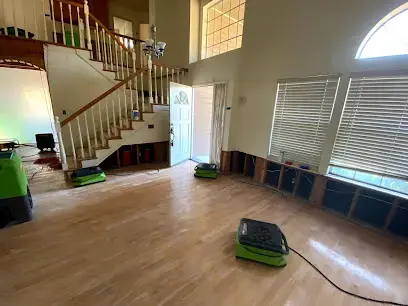
What to do first: structural drying in La Puente
- 1
Keep the equipment running
Leave air movers and dehumidifiers on day and night.
- 2
Keep doors and windows shut
A closed room dries faster than an open one.
- 3
Keep the HVAC setting steady
Ask the drying team how to set the thermostat.
- 4
Leave the readings to the team
Let the drying team decide when the room is dry.
Trade standards on this job
- Dry reference taken before drying starts
- Equipment sized to the class of the loss
- LGR dehumidifiers, desiccants for Class 4
- Drying log kept for the claim file
What does structural drying cost in La Puente, CA?
In La Puente, CA, structural drying typically runs $800 to $5,500, depending on the class of the loss, how many rooms are drying, the materials involved and how many days the equipment runs.
One room, Class 1 or 2
$800 to $1,800- Air movers and one dehumidifier
- Moisture mapping
- Daily readings
Several rooms
$1,800 to $3,800- Multiple LGR dehumidifiers
- Wall cavity drying
- Drying log
Class 4 materials
$3,800 to $5,500+- Hardwood or slab drying
- Desiccant dehumidification
- Extended monitoring
For a closer planning number, try the water damage cost calculator. A firm price comes from the restoration company after it sees the damage.
How structural drying is handled in La Puente
The order never changes: measure first, remove the water, dry, then prove it dry with readings.
(888) 578-6508Get La Puente drying started- 1
Map the moisture
The tech who does the walkthrough maps moisture with thermal imaging and pinless meters before any equipment goes down.
- 2
Pull the water
The extraction crew removes standing water with truck-mounted extraction, so it leaves the building instead of spreading.
- 3
Set the drying
The drying team sizes air movers and LGR dehumidifiers to each room's evaporation load and runs them around the clock.
- 4
Read, log, verify
The team logs readings daily until wet materials sit within 2 to 4 points of a dry reference, and the log goes into the claim file.
Structural drying is the part of a water loss that decides whether the problem comes back. Paint and carpet can feel dry within a day while the bottom plate, the drywall behind the baseboard and the slab underneath are still wet. The IICRC S500 is the industry drying standard, and it sets how a loss is classified, how the equipment is sized and how dry is verified.
Class 1 through 4
- Class 1: a small area with low-porosity materials, the least equipment
- Class 2: a whole room with carpet and wet walls up to about two feet
- Class 3: water from above that soaked ceilings, walls and floors
- Class 4: dense materials such as hardwood, plaster and concrete that need special drying, sometimes desiccant dehumidifiers
How the drying is set up
The tech who does the walkthrough maps moisture with thermal imaging and meters, and takes a dry reference reading in an unaffected part of the house. The drying team places air movers along wet walls to move air across the surfaces, and LGR dehumidifiers to pull the moisture back out of the air. In the dry months, La Puente's low outdoor humidity helps, but a closed drying chamber is still faster and more controlled than open windows.
Equipment comes out when the readings say dry, not on a set day. The goal is wet materials within 2 to 4 points of the dry reference.
Daily readings and the log
Every day the drying team records temperature, humidity and material readings, and moves or adds equipment as the numbers change. That log is what shows an adjuster the structure was actually dried. The EPA indoor air quality pages explain why moisture control matters, and Penn State Extension publishes material on how building materials hold moisture.
Where the team handles structural drying around La Puente
The restoration team covers all of La Puente, from Main Street and Amar Road to Hacienda Boulevard, plus Valinda, Bassett, Avocado Heights, Hacienda Heights, West Covina and the City of Industry.
ZIP codes 91744, 91746, 91747 and 91749.
See every area coveredStructural Drying in La Puente: common questions
What is the difference between structural drying and surface drying?
Surface drying makes things look and feel dry. Structural drying removes moisture from framing, drywall, subfloor and slab and proves it with readings.
How long does structural drying take?
A contained Class 1 or 2 loss usually dries in three to five days. Hardwood, plaster and concrete take longer.
Why are the machines so loud?
Air movers push a lot of air across wet surfaces, and dehumidifiers run compressors. They need to run around the clock to finish on time.
Can I turn the equipment off at night?
It is best not to. Turning it off lets humidity climb back up and adds days to the drying.
What is a dry reference reading?
A reading taken on the same kind of material in a part of the house that did not get wet. Wet materials are dried until they are within 2 to 4 points of it.
Is structural drying covered?
Drying is part of the mitigation on most covered water losses. Coverage depends on your policy, so it is worth checking with your own insurer.
Walls or floors still wet in La Puente? Call now.
Surface dry is not structurally dry. The drying team runs air movers and dehumidifiers until the readings meet the goal, across La Puente and the San Gabriel Valley.